
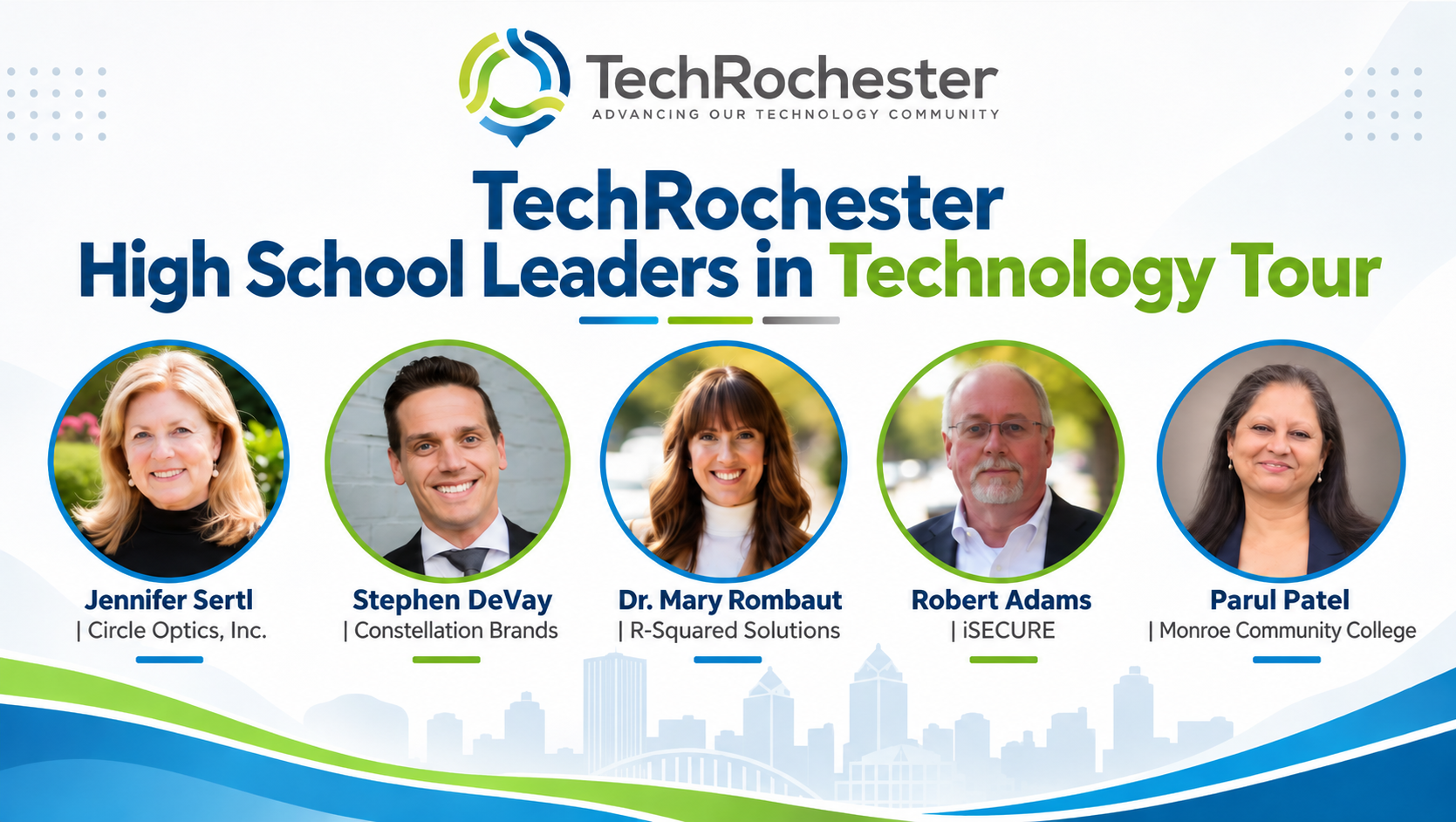
The goal of TechRochester's High School Leaders in Technology Tour is to expand students' exposure to ideas, encourage independent thinking, and build relationships between the people developing Rochester's technologies and the educators preparing its next generation.
The inaugural visit took place October 22, 2026, at Irondequoit High School, where business educator Jeanine Lent welcomed regional professionals to share their experiences and perspectives on careers, technology, and lifelong learning. Coordinated by TechRochester board member Jennifer Sertl of Circle Optics, the tour connects the region's technology community with students making important decisions about their futures.
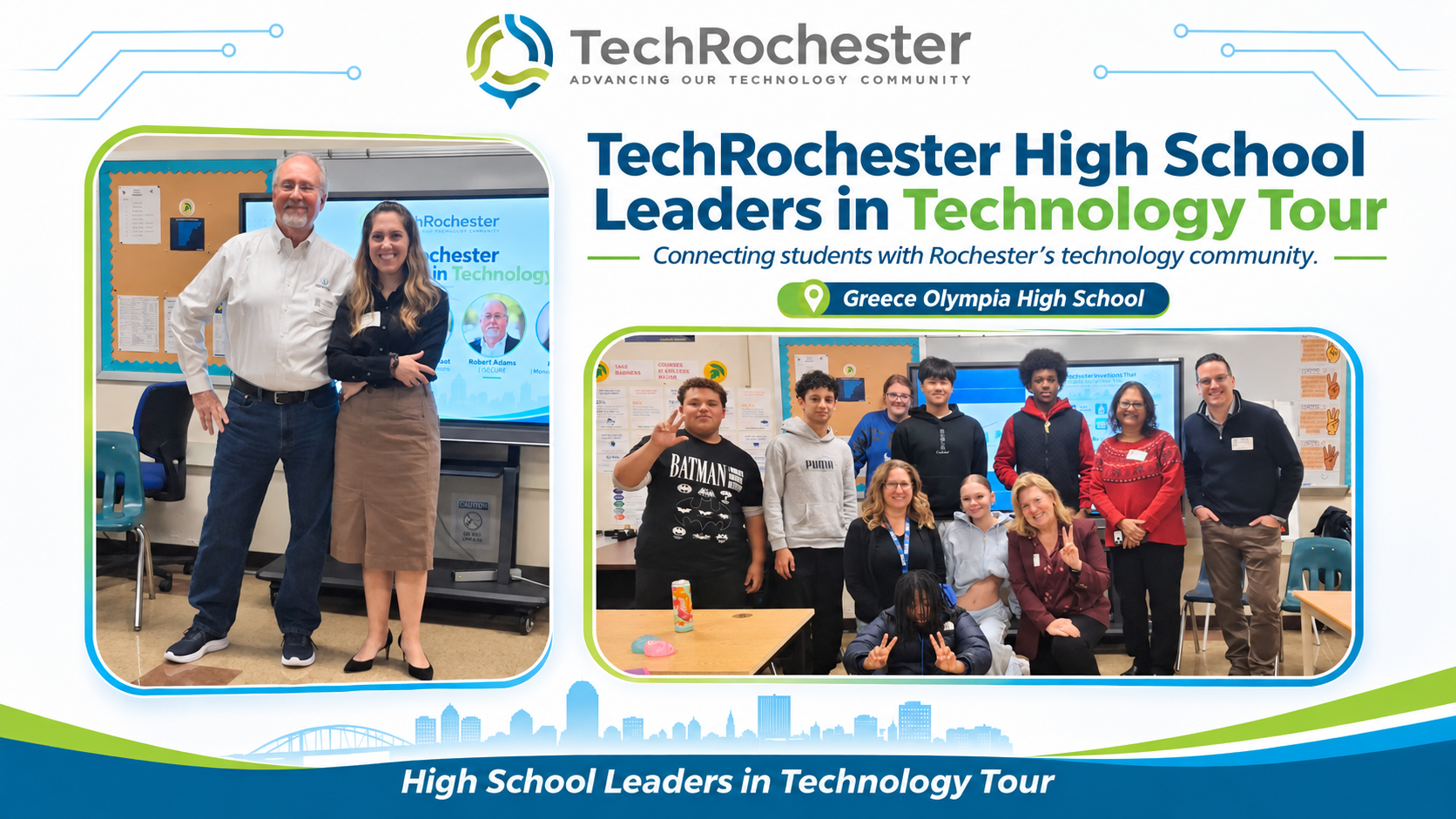
On November 11, the tour continued at Greece Olympia High School, where entrepreneurship teacher Andrea Garlock welcomed five professionals representing technology leadership, higher education, entrepreneurship, cybersecurity, and advanced imaging.
The speakers, in order of presentation, were Stephen DeVay of Constellation Brands, Parul Patel of Monroe Community College, Dr. Mary Rombaut of R-Squared Solutions, Robert Adams of iSECURE, and Jennifer Sertl of Circle Optics.
Each was invited to reflect on an important question: What do you wish your 18-year-old self had known?
Their stories revealed that professional success rarely follows a predictable route. More importantly, they demonstrated how curiosity, courage, financial decisions, relationships, and an openness to change influence the opportunities people create throughout their lives.
Stephen DeVay: Giving Yourself Permission Not to Know
Stephen DeVay, a technology leader at Constellation Brands, described entering college confident that computer science was his future. Within months, he realized that the daily work of programming did not match his interests.
Rather than abandoning technology, he explored software engineering and discovered a much broader industry encompassing project management, organizational processes, business strategy, and relationships with the people using technology.
Today, DeVay leads a team of project managers and agile coaches supporting initiatives across Constellation Brands, a global Fortune 500 company headquartered in Rochester. His career has taken him into industries and responsibilities he could not have anticipated when he first enrolled in college.
Reflecting on the pressure he experienced as a young student, DeVay shared: "I had no idea what I was doing. And I think in that moment, if somebody had just told me it's going to all work out, it's going to be fine and you don't have to know it all right now, that would have been amazing."
DeVay also emphasized that emerging technologies, particularly artificial intelligence, are changing the nature of professional work so quickly that even established leaders cannot predict every career that will exist in the future.
His experience offered students a different way to think about uncertainty. Rather than treating an unexpected change in direction as failure, they can view it as an opportunity to discover interests and abilities that were not evident at the beginning.
Key learning: You do not have to have your entire career figured out at 18. The ability to explore, adapt, and recognize new possibilities is itself an important professional skill.
Parul Patel: Opportunity Often Arrives Before Confidence
Parul Patel, IT Program Director at Monroe Community College, shared one of the morning's most compelling personal journeys.
She arrived in the United States from India at age 17 without speaking English. While learning the language and attending Monroe Community College, she began working at Xerox, initially performing repetitive equipment testing.
Rather than remaining within the limits of her assignment, Patel observed the technicians around her, developed new skills, and began solving problems independently. Those early experiences led to engineering responsibilities and eventually a career involving organizations including Xerox, Ford, Dell, and L3Harris.
Looking back on those early years, she explained: “I didn't have time to be ready. I just had to step in and figure it out."
Patel also shared a moment of regret. When a manager first offered her the opportunity to lead a team of peers, she declined because she was afraid. With the benefit of experience, she now sees that decision differently. "If somebody else sees something in you and they're willing to take a chance on you, you gotta take it."
Today, Patel works to align technology education with the needs of Rochester's employers, helping students access opportunities in a rapidly changing workforce. She also described programs that introduce young people to technology development and demonstrate how an idea can become a working solution.
Her career illustrates how an initial opportunity, even one that appears modest, can become the foundation for much greater responsibilities.
Key learning: Confidence does not always come before action. Sometimes it develops because we accept opportunities, ask for help, and learn what we are capable of accomplishing.
Dr. Mary Rombaut: Education, Risk, and Defining Success on Your Own Terms
Dr. Mary Rombaut of R-Squared Solutions challenged students to consider the relationship between education, financial decisions, and the lives they hope to build. A strong believer in education, she also spoke candidly about the student loan debt she accumulated and how those financial obligations affected her choices long after graduation.
Reflecting on her experience, Rombaut told the students: "My student loan debt by the time I was done was more than my house. And when you do that, it definitely impacts decisions you can make later."
She encouraged students to investigate different educational pathways, including community colleges and state universities, and to consider both the opportunities and financial responsibilities associated with each. Her point was not that students should avoid college, but that they should understand the investment they are making and the flexibility they may need later in life.
Rombaut also brought an entrepreneurial perspective to the discussion, sharing her experience developing an application that never achieved the commercial success she had hoped for. Although the venture did not succeed as intended, the knowledge and relationships that emerged from it contributed to her subsequent work. Her story demonstrated that taking a risk does not guarantee the desired outcome, but the experience can still create lasting value.
She encouraged students to consider their decisions in the context of a much larger question: "What you want out of your life, every one of you is different from the next person. But try to map your decisions towards that long term goal of what is going to give you the most meaningful, happy life that you can see in the future."
Key learning: Invest in your education thoughtfully, understand the risks and obligations that accompany your decisions, and remain open to learning from experiences that do not unfold as planned. Success is not simply reaching the next milestone. It is creating a life that reflects your own priorities and aspirations.
Robert Adams: Expertise Comes from Curiosity, Not Credentials Alone
Robert Adams of iSECURE challenged students to reconsider assumptions about how people develop professional expertise.
Unlike other panelists, Adams did not complete a traditional college degree. Instead, he built his career through independent learning, professional experience, technical exploration, and a persistent interest in understanding how things work.
Reflecting on his educational journey, Adams told the students: "I don't have a college degree. Mic drop. But I recognize very early on I did not have the mental mindset to sit in a classroom all day, but I had this incredible thirst for knowledge."
He emphasized that education extends far beyond classrooms and that many skilled trades now require a sophisticated understanding of technology. Electricians, HVAC specialists, automotive technicians, and other professionals increasingly work with complex electronic systems, software, and advanced equipment.
Adams also discussed the extraordinary opportunities and challenges emerging through artificial intelligence. While AI can streamline tasks and dramatically improve productivity, he cautioned students against confusing access to information with the ability to evaluate it.
"It's not a substitute for good skills. Also critical thinking. You need to be able to have critical thinking skills to look at the output of AI and know: is this a good idea? Is this a bad idea? Or is it right? Is it wrong?"
His perspective connected two themes central to the future of work: the growing importance of continuous learning and the enduring value of human judgment.
Key learning: Technology will continue to change how work is performed, but curiosity, independent learning, problem solving, and critical thinking remain essential foundations for professional success.
Jennifer Sertl: Understanding How Your Thinking Evolves
Jennifer Sertl, Vice President of Marketing and Partnerships at Circle Optics and a TechRochester board member, offered another perspective on careers in technology. With an academic background in existential philosophy, Sertl works alongside engineers and technical specialists developing advanced imaging technologies for defense and commercial applications.
Her experience illustrates that technology organizations need more than engineers and programmers. They also depend on people who understand strategy, communication, research, storytelling, partnerships, and the ability to frame challenges in new ways.
Sertl encouraged students to develop relationships with people whose experiences and perspectives could expand their own thinking. She emphasized the importance of asking for mentorship rather than assuming that successful professionals are too busy or inaccessible to help. She also introduced students to her longstanding practice of keeping a journal and conducting a weekly Plus/Delta reflection. The exercise involves identifying what went especially well and what one might approach differently in the future.
Explaining why she has maintained this habit for decades, Sertl observed: "We get photographs of how we look over time, but we don't get photographs of how our mind thinks over time."
She explained that reviewing past reflections allows her to recognize patterns, see how her judgment has evolved, and better understand the relationship between experience and personal growth.
Key learning: The ability to observe your own thinking, develop meaningful relationships, and learn from experience can be as valuable as the knowledge you acquire through formal education.
The Students Asked the Questions That Matter
Although the professionals arrived prepared to share their career experiences, some of the most meaningful moments emerged from the students' questions. They asked whether college was worth the investment, whether the speakers were satisfied with their careers, and whether their younger selves would be proud of the lives they had created.
They wanted to understand how professionals maintained friendships, relationships, and personal well-being while managing demanding responsibilities. They also raised questions about artificial intelligence and its potential to change the work available to their generation.
These were not simply questions about finding jobs. They were questions about making decisions, establishing priorities, and defining a meaningful life.
The panelists responded with candor, acknowledging mistakes, missed opportunities, difficult financial decisions, and periods when professional responsibilities had taken precedence over personal relationships.
Several reflected on the importance of establishing boundaries and recognizing that success should not be measured exclusively by job titles or financial accomplishments. The conversation demonstrated that learning does not move in only one direction. While students benefited from the experiences of established professionals, their questions also encouraged the speakers to reconsider assumptions and reflect on what they might do differently.
Rochester has a longstanding history of entrepreneurship, invention, advanced manufacturing, and technological innovation. The region's next generation of innovators may emerge from engineering laboratories, cybersecurity organizations, skilled trades, entrepreneurial ventures, or fields that have not yet been created.
The speakers' diverse backgrounds illustrated that there is no single pathway into the technology economy. A software engineering degree, community college education, doctoral studies, independent technical learning, or a background in philosophy can each lead to meaningful contributions. Just as important, the visit highlighted the role of educators who make these connections possible. Teachers such as Andrea Garlock and Jeanine Lent help students develop the confidence to ask questions, examine possibilities, and connect classroom learning to the world around them.
TechRochester's commitment is to continue building relationships between educators, students, and regional professionals who are willing to share not only their accomplishments, but also the experiences that shaped their judgment.
Rochester has a history of people seeing possibilities others haven't imagined yet. The question isn't what will be invented next. It's whether one of these students will be the person who invents it.
TechRochester thanks Andrea Garlock and Greece Olympia High School for hosting the visit, the participating professionals for sharing their experiences, and the students for the thoughtful questions that made the conversation especially meaningful.