
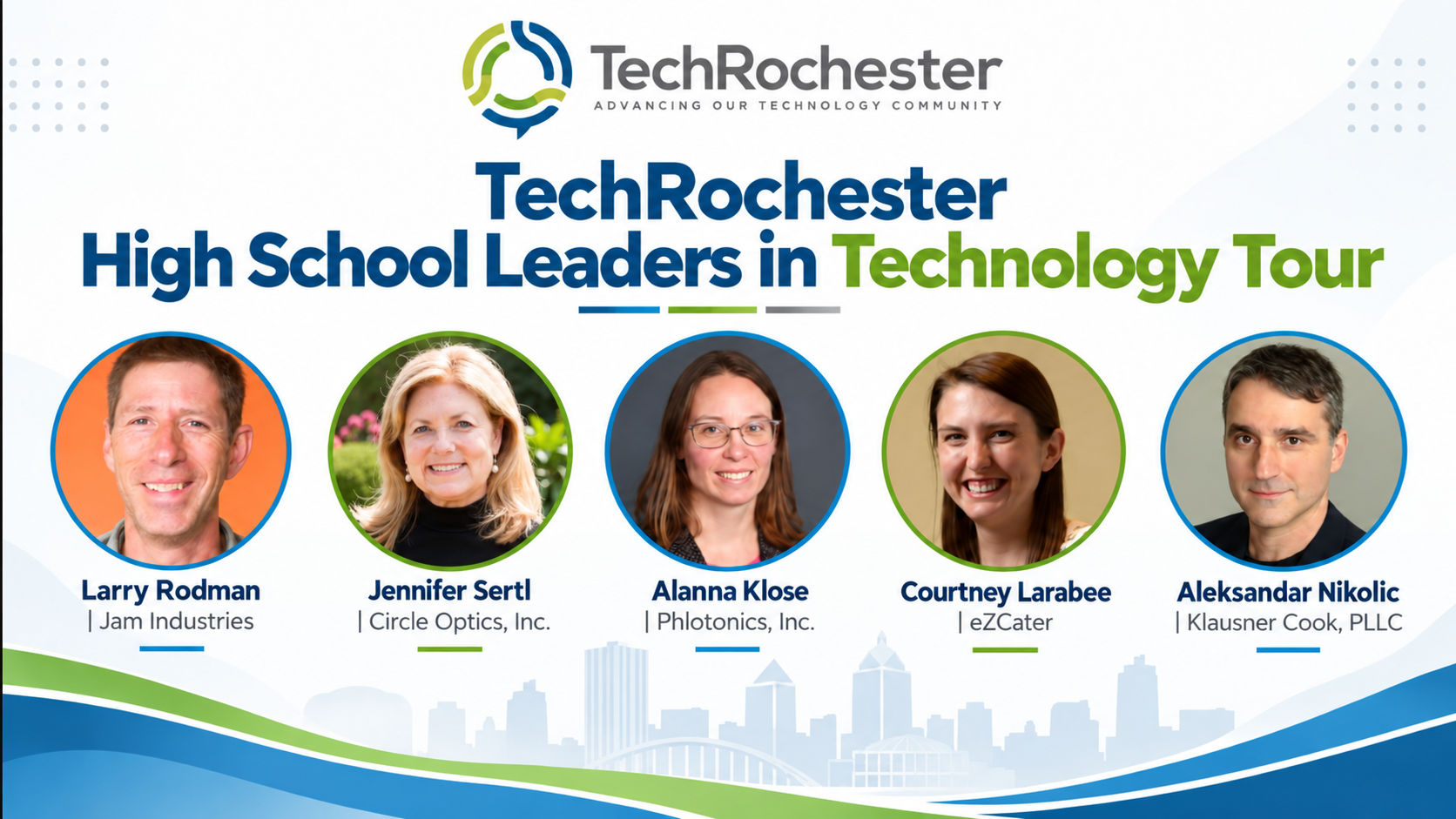
An inaugural visit to Irondequoit High School brings technology leaders and educators together to expand students' understanding of opportunity, innovation, and the skills that matter in a changing world.
For more than 25 years, TechRochester has connected the people, organizations, and ideas advancing Greater Rochester's technology community. Founded in 2000 as Digital Rochester, the nonprofit organization has evolved into a regional network committed to collaboration, professional development, and the relationships that strengthen innovation. Its mission, Advancing Our Technology Community, recognizes that a thriving technology ecosystem depends not only on technological achievements, but on the exchange of knowledge and experience across industries, institutions, and generations.
Through its High School Leaders in Technology Tour, TechRochester is extending that mission directly into Rochester-area high schools. The initiative brings two technology leaders into participating classrooms to share their experiences, engage with students, and support educators in connecting academic learning with the rapidly evolving world beyond school. Rather than prescribing a particular career path, the goal is to expand students' exposure to ideas, encourage independent thinking, and build relationships between the people developing Rochester's technologies and the educators preparing its next generation.
The inaugural visit took place October 22, 2026, at Irondequoit High School, where business educator Jeanine Lent welcomed four regional professionals: Larry Rodman of JAM Industries, Courtney Larabee of ezCater, Aleksandar Nikolic of Klausner Cook, PLLC, and Alanna Klose of Photonics Inc. Coordinated by TechRochester board member Jennifer Sertl of Circle Optics, the conversations connected advanced manufacturing, marketing technology, intellectual property law, and scientific research with broader lessons about curiosity, adaptability, mentorship, and human judgment.
Larry Rodman of JAM Industries brought a perspective shaped by leadership experience across technology companies including Monster and HubSpot, as well as his current work in advanced manufacturing. His journey demonstrated how knowledge gained in one environment can be transferred into another, and how understanding one's values can help guide important professional decisions. Speaking about the importance of meaningful work, Rodman encouraged students to think beyond compensation or job titles: "Work shouldn't be work, it should be your passion and never settle and find what is important to you." His experience also introduced students to the opportunities available through technical training, apprenticeships, and manufacturing careers that do not necessarily require a traditional four-year degree. The broader lesson was that learning is continuous, and that discovering what matters personally is an important part of making purposeful decisions.
Courtney Larabee of ezCater introduced students to the ways technology, marketing, data, and entrepreneurship intersect. Having worked in both large organizations and emerging technology companies, she described how conversations with colleagues and exposure to unfamiliar disciplines helped her recognize opportunities she had not previously considered. Her advice emphasized experimentation rather than the expectation that young people must know exactly where their decisions will lead. "Just because you set yourself on a path doesn't mean you're stuck in that path. So I always tell myself, try it. If you don't like it, it's not permanent." Larabee also encouraged students to remain curious about the people around them, recognizing that an unexpected conversation can introduce an entirely new direction. Her experience demonstrated that adaptability is not simply a response to change; it is a capability students can intentionally develop.
Aleksandar Nikolic of Klausner Cook, PLLC offered a perspective on the intersection of engineering, robotics, software, and intellectual property law. Working with startup companies to protect their innovations, he demonstrated how knowledge from seemingly unrelated disciplines can become valuable when applied together. His discussion emphasized the importance of mentorship, curiosity, and asking questions, particularly when students encounter subjects they do not immediately understand. "Sometimes you'll find mentors in the strangest places. ... Don't be afraid to ask questions. ... Try and be curious about things." Nikolic also discussed perseverance through educational and professional transitions, reinforcing that uncertainty and unexpected challenges are not necessarily obstacles to progress. His message encouraged students to approach unfamiliar experiences as opportunities to develop both knowledge and relationships.
Alanna Klose of Phlotonics shared a journey that connected scientific research, teaching in Rwanda through the Peace Corps, continued education, and the commercialization of photonics technology. Her experience illustrated how learning can deepen when people are challenged to apply their knowledge in unfamiliar environments. Through teaching science to students with limited English proficiency, she rediscovered the importance of fundamental scientific principles and the ability to communicate complex ideas clearly. Her advice reflected the role that relationships and observation play in learning: "Build strong relationships with people who are kind, who are helpful, and who are very smart. If you see someone who's doing something that you admire, stick with them." Klose's experience reinforced that education extends beyond formal instruction, and that curiosity, collaboration, and the willingness to learn from others can create opportunities that are difficult to anticipate.
The classroom conversations extended beyond professional experience into questions about higher education, practical skills, mentorship, and the influence of artificial intelligence. Students explored how professionals make decisions, develop expertise, and respond when technology changes the nature of their work. The discussion also raised questions about AI literacy, intellectual property, independent judgment, and the responsibility to understand the tools increasingly shaping education and employment.
Sertl, who also teaches at Rochester Institute of Technology, encouraged students to recognize that technological competence is only one dimension of their future success. As artificial intelligence becomes increasingly integrated into everyday decisions, she emphasized the enduring value of attention and authentic human connection. "Your competitive advantage isn't your intellect. Your competitive advantage isn't your test scores. Your competitive advantage is that when people meet you, they experience someone fully present. Paying attention. That is your superhuman app." The observation connected a discussion about emerging technology with a fundamental human capability: the ability to listen, establish trust, and engage meaningfully with others.
For educators, the value of these exchanges reaches beyond any individual presentation. Bringing working professionals into classrooms creates opportunities to connect curriculum with practical applications, introduce emerging disciplines, and help students understand how knowledge develops through collaboration. The visits also give technology professionals an opportunity to listen to the questions and perspectives of students whose experiences will shape the future workforce and innovation community.
“High school is the perfect time for young people to explore career pathways and learn valuable skills from experts in our community. Connecting community leaders to classrooms provides an opportunity for young people to see what options are in the workforce and what they need to be prepared for to be a successful member of our society.” Jeanine Lent is a Business, Entrepreneurship, Law and Personal Finance teacher for 25 years at Irondequoit High School. Her students enjoyed the life lessons and learned great advice from the guest speakers.
Following the sessions, conversations continued about how TechRochester might make industry expertise more accessible to educators through future classroom visits, practical demonstrations, and connections between academic subjects and the work being done in Rochester's technology organizations.
The inaugural visit represents the beginning of a broader commitment to building relationships between schools and the regional innovation community. When educators can draw upon the knowledge of working professionals, students gain access to perspectives that complement classroom instruction. When technology leaders engage directly with students, they gain a better understanding of the next generation's questions, interests, and developing capabilities.
The opportunity is larger than introducing students to technology careers. It is about creating an exchange of knowledge between generations, strengthening the relationship between education and industry, and helping young people develop the curiosity, discernment, adaptability, and human connections that will serve them throughout their lives.
Through the High School Leaders in Technology Tour, TechRochester is putting its mission into practice by building those bridges—connecting Rochester's innovation community with the classrooms where its future is taking shape.
